
Why ‘human content’ is becoming a competitive advantage in the AI age
AI has undoubtedly made creating content easier, but it has also made much of that content more forgettable. Scroll through LinkedIn for a minute, and a pattern soon emerges; much of the content sounds strikingly similar.
For the last two decades, the biggest challenge in content marketing has been ‘production.’ There was never enough time, resources, or budget to create the level of output needed (in fact, I remember editing a piece by one of GatherContent’s founders, Angus Edwardson, called ‘Content has never been more important, but it’s never been harder.’ This was back in 2021).
Today, you could say that constraint has largely disappeared. AI can generate blog posts, emails, landing pages, and social copy in seconds. Strategy documents can be drafted from a well-structured prompt. Entire content pipelines can be concocted in minutes.
But despite all of this, most of that content feels interchangeable. It may be polished, structured, and technically correct, but it has no heart or soul. And that’s what makes people stop and engage.
In a crowded content environment, that difference really matters. Content that captures attention is far more likely to drive engagement, build trust, and influence buying decisions.
AI can generate content at scale, but trust in that output remains limited. In fact, only 4% of marketers report a high level of trust in AI-generated content — reinforcing the need for human judgement in shaping what gets published.
The shift from content production to content perception
Besides advancements in AI, there’s a more fundamental shift happening right now: how content is experienced by your audience.
We’ve moved from “do we have enough content?” to “does any of our content actually stand out?”
And brands relying heavily on AI for content strategy and production are already struggling with this. In fact, recent research shows that 94% of B2B marketers feel trapped in a ‘sea of sameness’, a signal that producing more content is no longer the challenge, but making it distinctive is.
So much GenAI content is optimised for efficiency over expression, so while it ticks ‘SEO’ and ‘brand guideline’ boxes, it’s rarely unveiling anything new or thought-provoking.
That’s where human content starts to matter.
What ‘human content’ actually means (and what it doesn’t)
When we say ‘human content’, it’s not about completely rejecting AI. It’s about ensuring your content conveys a clear, intentional point of view or idea, and is not just a summary of something.
Human-led content uses judgement, taste, and experience. It draws on real examples and reflects original thinking. And it feels more recognisable, not just in tone of voice, but in how the ideas are framed and expressed.
In a nutshell? AI can generate content… but humans are what make it worth reading.
Why ‘polished’ content is starting to work against you
For years, good content meant clarity, consistency, and writing quality, but now those same things can signal ‘sameness’. Perfection increasingly reads as artificial, while slight imperfection signals authenticity; a shift that challenges how many brands approach content quality today.
AI will naturally produce structured, predictable outputs. Internal style guidelines smooth out anything that dares break a branding rule. Approval processes further reduce the possibility of variation across your content, removing the ‘risk’ — but also the personality.
This creates very ‘safe’ content, and that makes it easy to ignore and scroll past. Your audiences are not necessarily looking for content that’s really ‘rough around the edges’, but they are looking more closely these days for signs of originality, intent, and a distinct perspective.
The rise of recognisable content
The brands and creators gaining traction right now tend to have several things in common:
They use more direct language.
Content is more opinion-led.
There’s more visible authorship.
All of these are incredibly difficult to replicate with AI alone. What’s more, they are not driven by a set format or template; there’s consistency of thinking from content piece to content piece. It’s that consistency that makes content recognisable, and recognition is what builds trust over time.
That’s where human input starts to become a competitive advantage.
Where most brands get stuck
Many teams are currently operating in an awkward ‘middle ground’. They’re trying to use AI to scale content production while still measuring success primarily through output-related metrics.
More content on more channels doesn’t guarantee more impact. The missing layer isn’t linked to production capability; it’s editorial direction. It’s what you choose to say and what you choose not to say.
What brands need to do differently
If human content is becoming a competitive advantage, the challenge is embedding it into your content strategy without losing the efficiencies AI provides.
In practice, this doesn’t require a complete overhaul; it starts with small shifts in how content is planned, created, and evaluated, and how your teams define what ‘good’ actually looks like.
1. Prioritise point of view over publishing volume
Content that tries to say everything about a topic often ends up saying very little that’s worth taking away.
The content that tends to resonate now is more deliberate; it takes a stance, frames a problem in a specific way, or highlights something others may have overlooked.
In a landscape where so much content is now technically ‘correct’, it’s clarity of thinking that stands out. That might mean challenging a common best practice or focusing on one overlooked aspect of a broader topic rather than trying to cover it comprehensively.
In practice, this could mean that your team reduces the number of SEO-led pieces produced each month in favour of writing fewer, more opinionated pieces that link directly to your organisation’s expertise or perspective on the market.
Companies like Basecamp (37signals) have spent years building up audience recognition by consistently publishing content that takes clear, often contrarian positions on subjects like work, productivity, and software.
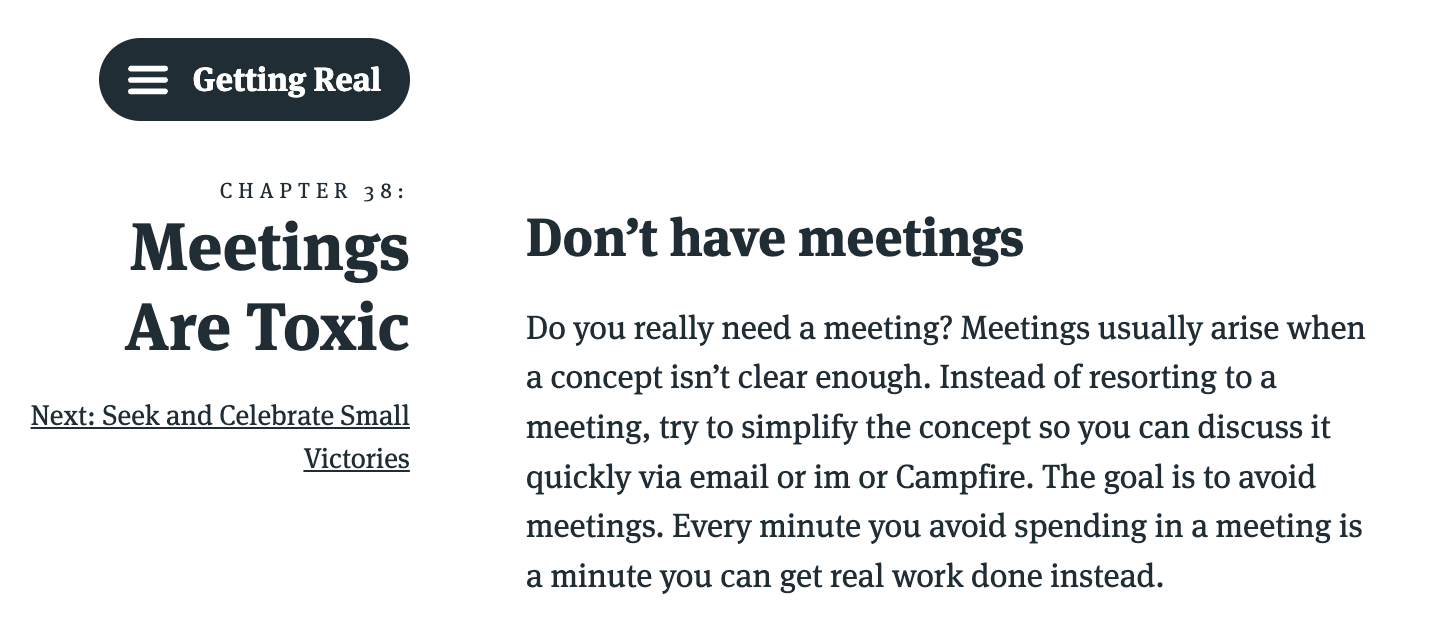
Image taken from a Basecamp Getting Real blog
Whether it’s founder-led writing, books like Rework, or long-form essays, Basecamp’s perspective remains unmistakably theirs.
2. Bring real voices closer to the content
Too often, brand content is written around expertise rather than shaped by it, resulting in something that feels polished but ultimately generic.
The brands cutting through the noise with their content right now are finding ways to involve their founders, subject matter experts (SMEs), and senior leaders more directly. That’s not to say that these figureheads need to write everything themselves, but they can actively influence the direction, tone, and substance of what gets published.
Gong is a strong example of this approach working in practice. A large proportion of its content is shaped by insights from sales teams, internal subject-matter experts, and customer conversations, rather than written as regular top-of-funnel commentary.
Its Gong Labs content, for example, takes data from real sales calls and customer interactions and analyses them, often resulting in pieces that challenge common assumptions made about buyer behaviour and how the sales process works.

Image from Gong’s blog, Effective small talk techniques to build rapport
It provides Gong with a distinctive voice rooted in credibility and first-hand experience, using content that reflects how the company actually thinks, operates and works with its customers.
This allows it to stand out strongly against a sea of otherwise generic industry content.
3. Treat AI as a starting point, not the final version
We know that AI is really effective at generating structure and accelerating early-stage work, but if the output is treated as final, it usually leads to content that feels familiar rather than distinctive.
Many content teams are adapting their workflows accordingly, using AI to generate ideas, outlines, and content repurposing suggestions. But what makes content memorable still comes from human judgment; what we choose to emphasise, leave out, and express.
That final layer is where differentiation happens, and it’s often the deal-breaker between something that reads well and something that actually sounds like your brand.
Shopify is a useful example of a brand that appears to provide exactly this balance. While the company has embraced AI across parts of its marketing ecosystem, its strongest content still reflects clear human-led editorial direction and points of view around topics like commerce and business growth.
Used in this way, AI can help teams like those at Shopify to scale ideas, repurpose content across channels, and maintain consistency, all without sacrificing originality.
4. Rethink how you measure content success
Audience reach still matters, but recognition is becoming a far more meaningful metric. In other words, in environments already saturated with marketing content, being seenisn’t the same as being remembered.
A useful test is to imagine whether your content is identifiable without any branding. When people start to recognise how you think and how you communicate, not just what you publish, that’s when consumer trust begins to build. That means looking beyond top-level metrics like impressions and clicks and paying close attention to signals like returning audiences, branded search growth, and how often your brand’s content is being shared or referenced by your audience.
For instance, are prospects referencing your content before speaking to your sales team? Or are you seeing a sharp uplift in insight newsletter subscriptions?
Over time, this shift toward recognition and consistency can have a direct impact on marketing performance, from higher engagement rates to stronger brand recall and more efficient conversion across channels.
5. Allow for some flexibility within the brand guidelines
As we’ve already covered above, a lot of drafted content loses its edge in the final stages, with brand guidelines, approvals, and ‘risk reduction’ smoothing everything out.
But if everything is always 100% ‘on-brand’, nothing will ever stand out. That doesn’t mean abandoning consistency altogether, but rather knowing where you could ‘flex’ it. That could mean tone, structure, format, or opinion.
The brands creating more interesting, distinctive content at the moment are usually the ones willing to leave a little room for personality.
To take one demonstration of this, Duolingo has shown how controlled flexibility in tone of voice can make content significantly more recognisable to audiences. While the company maintains a consistent visual identity, its social content regularly bends conventional ‘brand-safe’ expectations in ways that feel unmistakably human and culturally relevant.

Image taken from this Duolingo X post
For example, a running joke about brand mascot Duo the owl’s ‘Dua Lipa obsession’ created a recurring social narrative that audiences on social media started getting involved with.
Why audience perception matters more than content volume
AI has made content easier to produce, but it has also made it easier to ignore. As more brands rely on the same tools and structures, the real point of difference shifts. Differentiation increasingly comes from perspective and intent.
Audiences are already responding to this shift. They are not only able to evaluate clarity and consistency in your marketing content, but also whether that content feels authentic and purposeful.
The brands pulling ahead in the market are not those producing the most content, but those creating content people recognise, remember, and trust… because it feels like it came from someone, not something.
FAQs:
-
Human-led content is content shaped by human judgement, experience, and editorial direction rather than being fully generated by AI.
While AI can help accelerate drafting and research, human-led content reflects original thinking, clear perspectives, and recognisable brand voice.
It often feels more authentic because it is influenced by real expertise, customer understanding, and strategic intent.
-
AI tools are trained on existing patterns and published material, which naturally leads to similar structures, phrasing, and ideas appearing repeatedly across content.
When many brands use the same tools, prompts, SEO practices, and approval processes, content can quickly become interchangeable.
Without strong editorial direction or distinct perspectives, AI-generated content often prioritises ‘efficiency’ over ‘originality.’
-
AI is unlikely to fully replace human content writers because strategy, perspective, emotional intelligence, and editorial judgement still require human input.
AI is highly effective at speeding up production workflows, generating outlines, summarising information, and repurposing content, but human expertise remains essential for differentiation, brand positioning, storytelling, and trust-building.
-
Brands can make AI-assisted content feel more human by involving subject matter experts, using original examples and customer insights, developing stronger editorial perspectives, and treating AI-generated drafts as a starting point rather than a finished product (see the article above!).
The brands standing out right now are combining AI efficiency with recognisable tone, opinion-led thinking, and visible human authorship.
=====
Now that you’ve read this, you may be interested in: