
From putting links in comments to obsessing over follower numbers, some familiar LinkedIn 'rules' deserve a closer look. So here, I’ve tried to find actual evidence to either back up or debunk the most common assumptions about LinkedIn.
For every supposed secret to beating the LinkedIn algorithm, there's someone confidently explaining why it works. And usually someone else explaining why it doesn't…
I've worked with a ton of B2B social media accounts now, and I know how frustrating this can be. So, as we head into a new year, I thought it would be worth investigating some of LinkedIn's most ‘persistent’ myths.
Not just by relying on social media experts or another enormous dataset of LinkedIn posts, but by looking at what LinkedIn itself has said.
Here are the eight LinkedIn myths I'm questioning:
Myth 1: Putting your link in the first comment boosts engagement
Myth 2: External links in LinkedIn posts automatically kill your reach
Myth 3: You need hashtags to maximise LinkedIn reach
Myth 4: You have to post every day to succeed on LinkedIn
Myth 5: There's one perfect time to post on LinkedIn
Myth 6: Video is always the best-performing LinkedIn format
Myth 7: LinkedIn Company Pages are a waste of time
Myth 8: The more followers your Company Page has, the more successful it is
Myth 1: Putting your link in the first comment boosts engagement
The verdict: Not a proven shortcut.
A business publishes a post promoting its latest report, webinar, or blog, then finishes with the familiar instruction: 'Link in the comments.'
The thinking is that LinkedIn doesn't want people leaving the platform, so moving an external link into a comment somehow protects the post's reach.
But does it? The evidence is less conclusive than the advice suggests.
Buffer's October 2026 analysis found that posts where the author added a link in their own comment received approximately 15% more impressions than comparable posts without links.
However, Buffer also acknowledged that the finding came from a limited subset of accounts and wasn't proof of an algorithmic advantage. And then there’s the fact that ‘more impressions’ is not the same thing as ‘more engagement.’
Another October 2026 study from NBK Social Research, analysing 74,119 public LinkedIn posts from prominent creators, found virtually no engagement advantage associated with the 'link in comments' approach.
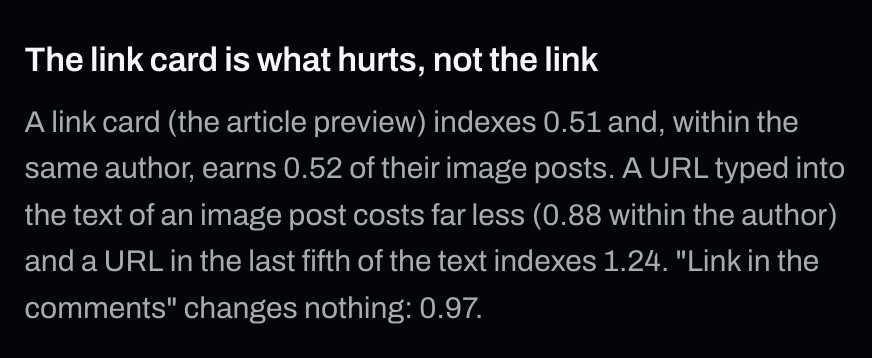
Above: From NBK Social Research’s ‘What Works on LinkedIn’ (2026)
There's another problem that often gets overlooked, too. The first comment on a post isn't necessarily the first comment everyone sees.
In 2026, LinkedIn's Senior Director of Product Management, Rishi Jobanputra, explained how the platform personalises comment rankings according to relevance, professional interests, and engagement activity. So… your carefully placed link might not be as prominent as you'd expect.
For B2B marketers trying to drive traffic to a report, webinar registration page, or customer story, that's hardly ideal.
The takeaway: If you want people to click through to something, make it easy for them. Test both approaches if reach is your priority, but don't assume making people search for a link automatically improves performance.
Myth 2: External links in LinkedIn posts automatically kill your reach
The verdict: LinkedIn says there's no automatic penalty. The performance data is more complicated.
This is closely related to the first myth, but there's an important difference: the question here is whether LinkedIn deliberately penalises posts simply because they contain an external URL.
Again, it was Rishi Jobanputra from LinkedIn who addressed this directly:
His explanation was that LinkedIn doesn't automatically limit a post's distribution because it contains a link. The important thing is that the post provides enough context and value to stand on its own.
However, that doesn't mean posts containing external links perform equally well. For example, Metricool's 2026 LinkedIn study found that Company Page posts containing links generated 51% more impressions than the Company Page average.
And for personal profiles, the opposite pattern appeared: posts with links generated 27% fewer impressions.
Buffer's own analysis of posts from more than 58,000 accounts also found lower average impressions for link posts, particularly those displaying link previews.
None of this establishes that LinkedIn deliberately suppresses outbound links. The type of content, audience, account, and purpose of the post can all influence the outcome.
The takeaway: Stop treating every external link as a liability. If you're sharing a useful article, promoting a webinar, or directing people towards a resource, give them a reason to click and make the destination easy to find.
Myth 3: You need hashtags to maximise LinkedIn reach
The verdict: LinkedIn says they're optional.
Here's one that should save everyone a little time, because, for years, marketers were encouraged to research hashtags, choose a carefully balanced selection, and include them in every post…. but LinkedIn's own product team has been rather more relaxed about the whole thing.
In a video posted in summer 2025, Rishi Jobanputra described hashtags as “nice to have, not a need to have.”
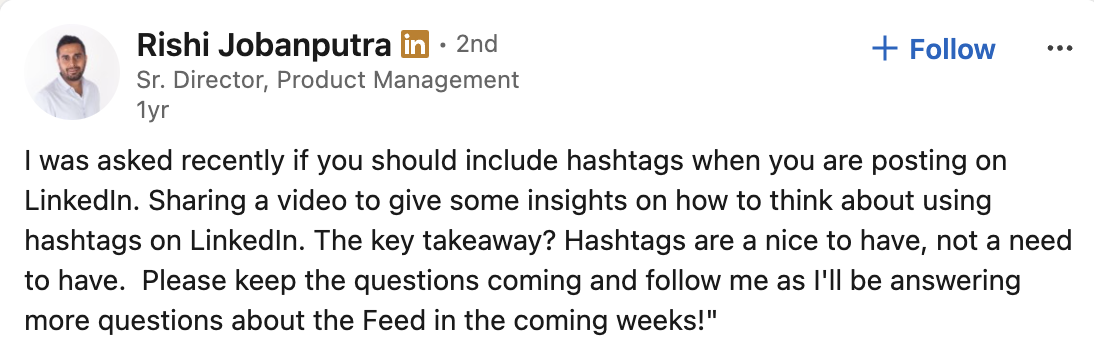
He went on to explain that LinkedIn's feed algorithms have become much better at understanding the subject of a post and matching it with relevant audiences, without relying on hashtags.
But that's not to say they have no purpose. ‘Relevant’ hashtags can still help people find particular subjects, and some third-party research has identified positive associations between hashtag use and post performance. It’s just that this isn’t a dead cert for increasing the reach of your post.
These days, there's certainly no need to include three to five hashtags simply because somebody insists that's the magic number (something I was doing for clients up until recently!).
The takeaway: Use relevant hashtags when they make sense, but don't spend longer selecting them than writing something worth reading. The subject matter, relevance, and value of your post deserve far more attention.
Myth 4: You have to post every day to succeed on LinkedIn
The verdict: Consistency helps, but daily posting isn't compulsory.
This is one of those pieces of advice that's particularly unhelpful for smaller marketing teams. “LinkedIn rewards consistency, so you should post every day. Preferably more than once… otherwise, the algorithm will forget you exist!”
LinkedIn's own Page best-practice guidance highlights the benefits of weekly posting, while Buffer's analysis of millions of LinkedIn posts found that higher posting frequency was associated with stronger performance.
But those findings shouldn't be interpreted as an ‘instruction’ to publish daily regardless of whether you've got something worth saying or not.
There's also an obvious practical consideration. A B2B marketing team with several products, campaigns and audiences can quickly end up creating content primarily to satisfy its publishing schedule. And that's how we end up with endless corporate updates that communicate very little...
The more useful question is how frequently you can publish content your audience genuinely wants to see.
For some organisations, that might be five times a week. For others, two or three carefully planned posts might be more realistic.
The takeaway: Establish a sustainable cadence, always measure the results, and increase frequency if you've got the content and resources to justify it. Publishing something mediocre “because it's Wednesday” isn't much of a strategy.
Myth 5: There's one perfect time to post on LinkedIn
The verdict: Timing matters, but there's no universal ‘magic hour’.
If you've ever researched the best time to post on LinkedIn, you'll know how confusing the recommendations can be. The advice changes depending on which study you're reading… and there are many out there right now.
For example, Buffer's September 2026 analysis of 4.8 million posts identified ‘Wednesday at 4pm’ as its strongest overall time slot.
LinkedIn itself advises marketers to take a more individual approach.
In a post addressing this exact question, Rishi Jobanputra explained that publishing when your audience is online can help create early momentum, but strong, relevant content can continue reaching people for days.:
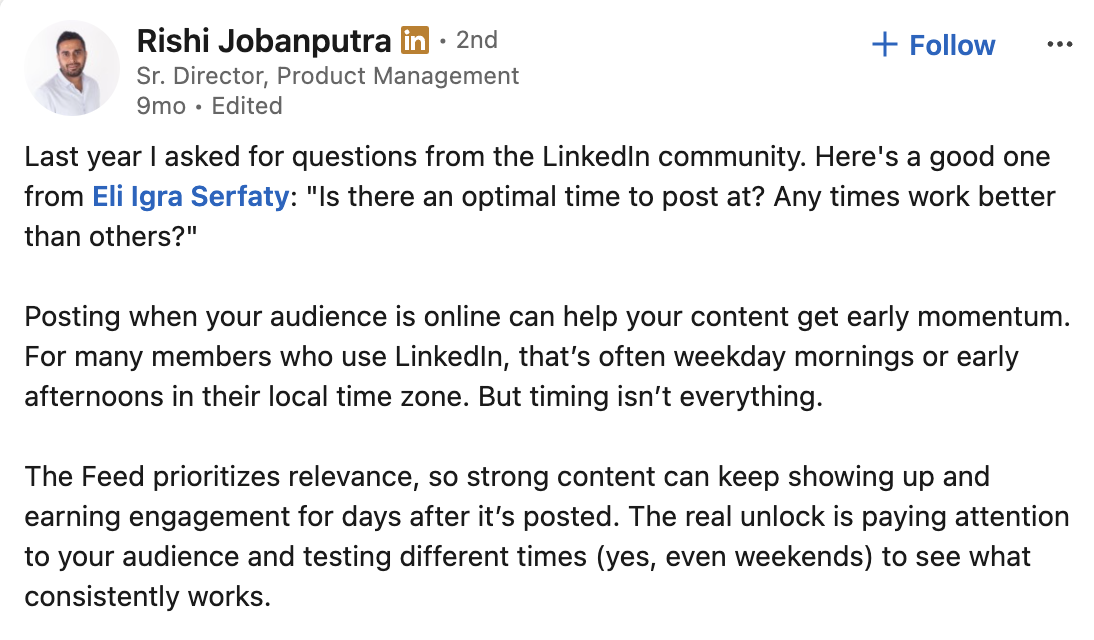
His advice was to test different times and pay attention to when your particular audience responds — which makes sense, because a B2B manufacturer targeting US procurement teams probably doesn't need the same posting schedule as a UK recruitment agency or a global technology company.
Even within one organisation, different audiences might behave very differently.
The takeaway: Use industry benchmarks as a starting point, not as a rulebook. Look at your audience geography, engagement patterns, and content performance, then keep adjusting accordingly.
(And don't ever assume a post failed because you published it at 10:15am instead of 9:45am.)
Myth 6: Video is always the best-performing LinkedIn format
The verdict: Not according to the latest comparative research...
LinkedIn has been encouraging marketers to use video for years, and for good reason. Video can be excellent for demonstrating products, sharing customer experiences, communicating complex ideas, and putting actual people in front of an audience.
BUT! Somewhere along the way, 'video is valuable' became 'video always performs best'. And those aren't the same thing.
Metricool's April 2026 study analysed 673,658 posts and found that carousels and multi-image posts outperformed standard video posts across several important engagement measures. This is particularly interesting because LinkedIn's own longstanding Page best-practice guidance promotes video as a strong engagement format.
And the thing is… both can be true. Video might outperform certain alternatives in particular contexts, while another format performs better for a specific objective, audience or dataset.
And of course, not every video is worth watching. A genuinely useful carousel explaining a technical process could achieve better results than a 90-second video of someone reading a script about it.
The takeaway: Choose the format that suits the message, not the one you've been told ‘the algorithm prefers’. Test videos, documents, multi-image posts, and simpler formats against the outcomes you actually want.
Myth 7: LinkedIn Company Pages are a waste of time
The verdict: A Company Page has a different role to a personal profile.
There's a growing school of thought that businesses should concentrate almost entirely on their executives and employees, because people engage with people rather than brands.
There's certainly evidence that personal profiles generate stronger engagement, but the same Metricool research we mentioned above found an average engagement rate of 2.60% for personal profiles, compared with 1.60% for Company Pages.
The same study also found that Company Page posts were more likely to be shared.
So, it might well be that personal LinkedIn profiles can be excellent for sharing perspectives, starting conversations, and building relationships around individual expertise, while a Company Page serves brilliantly as a central place for organisational news, product announcements, events, customer stories, job opportunities, and authoritative company information.
So rather than choosing between the corporate account and employees, why not make them complement each other? For example, a Company Page can distribute an important report, while its author or a subject matter expert shares their interpretation of its findings from their own individual profile.
The takeaway: Don't expect your Company Page to behave like an individual's profile. Use it for what it's good at, while encouraging employees to contribute genuine perspectives through their own accounts.
Myth 8: The more followers your Company Page has, the more successful it is
The verdict: Follower numbers matter, but they're a poor measure of success on their own.
I've seen how much attention follower growth can receive in B2B social media reporting. And I understand why. It's a really easy number to track. It's visible to everyone. And being able to report that your Company Page has gained another 2,000 followers looks reassuring on any monthly board meeting slide.
But what does having 50,000 followers actually tell you? It doesn’t tell you whether they're potential customers, and it doesn’t tell you how much anyone is actually engaging with your content.
And it certainly doesn’t tell you whether your LinkedIn activity is contributing to the overall objectives of the business...
Interestingly, LinkedIn's own analytics tools support a much broader view of what makes a successful Company Page.
Its follower analytics guidance explains how administrators can examine their followers by location, seniority, job function, industry and company size. Meanwhile, its Page analytics guidance encourages marketers to monitor content performance, visitors, search appearances and engagement alongside follower growth.
In other words, LinkedIn gives you ways to understand who is following your business and what they're doing, not simply how many of them there are.
There's a similar problem with judging posts by the ‘number of likes’ they attract.
One post might receive hundreds of reactions because it makes a widely relatable observation. Another might attract far fewer likes but prompt several relevant prospects to visit your website.
Which one performed better? That depends entirely on what you wanted it to achieve.
None of what I say above means that follower growth is totally irrelevant. A larger, relevant audience of course creates more opportunities for visibility, engagement, and brand awareness… but attracting followers and attracting commercially valuable followers aren't necessarily the same thing.
The takeaway: Track follower growth, certainly. But pay at least as much attention to audience relevance, engagement quality, reach among your target market, and the actions people take after encountering your content.
What should LinkedIn marketers focus on now?
After looking through all this advice and research, I think there's a fairly obvious pattern.
The more a LinkedIn recommendation sounds like a universal rule, the more suspicious we should probably be of it.
“Always use hashtags.” “Never include links in your post.” “Post at exactly this time.” “Only use this format.”
Real marketing doesn't work like that. Your audience, objectives, resources and content all influence what will be effective.
And LinkedIn itself is changing. The company continues to roll out updates every so often, announcing changes to its feed, including more sophisticated systems for understanding content relevance and efforts to reduce engagement bait, repetitive posts, and inauthentic interactions.
By September 2026, it was reporting a 40% reduction in views of material it classified as AI slop.
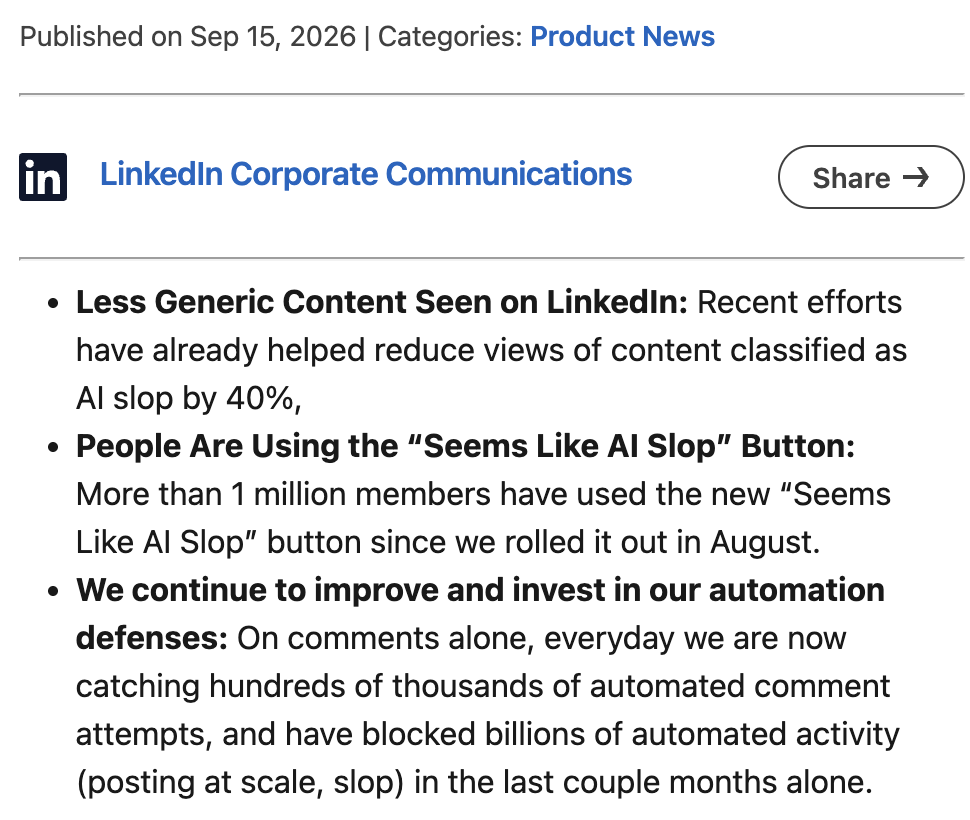
That doesn't mean every LinkedIn algorithm trick is suddenly irrelevant, or that we should ignore performance data; it means marketers might benefit from spending a little less time attempting to second-guess the algorithm and a little more time understanding the people they actually want to reach.
For me, that means creating content with a clear purpose, sharing genuine expertise, testing different approaches, and paying attention to results that matter beyond the platform itself.
It's not particularly revolutionary advice, but perhaps that's preferable to another year of being told to move your links around, rearrange your hashtags, and publish at precisely 8:17am on a Thursday.
======
Want more LinkedIn data? My regularly updated guide to LinkedIn statistics and trends for B2B marketers brings together research on audiences, engagement, content formats, and B2B marketing.